
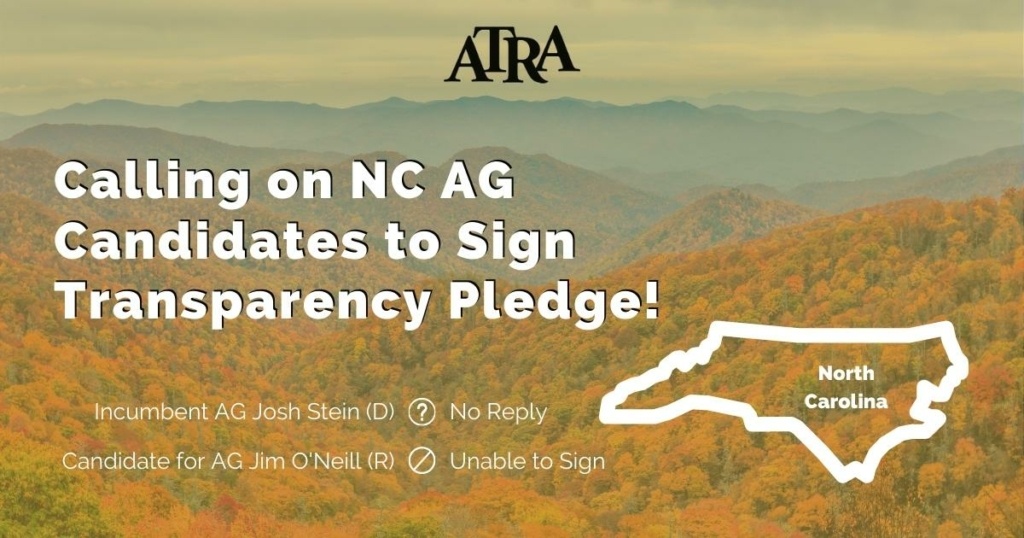
North Carolina AG Candidates Fail To Embrace Government Transparency
ATRA reports North Carolina attorney general candidates’ inaction on transparency code pledge.
The major party candidates vying for the office of attorney general in North Carolina do not support good-government principles, the American Tort Reform Association reports.
Neither incumbent Attorney General Josh Stein (D) nor Republican candidate, Jim O’Neill, agreed to sign ATRA’s Attorney General Transparency Code pledge, the 2020 State Attorney General Candidate Questionnaire.
“We are disappointed North Carolina voters do not have an attorney general candidate committed to common sense transparency standards,” ATRA President Tiger Joyce said. “However, there is still time before the election and we urge both incumbent AG Josh Stein and his opponent Jim O’Neill to sign the pledge and demonstrate that, if elected, they can indeed commit to transparent, accountable government.”
ATRA developed the Transparency Code as a collection of model policies to govern the use of outside counsel by state attorneys general. Attorneys general play a critical role in creating a fairer system for all as their state’s head law enforcement officers.
Twenty-three states, including North Carolina, have passed laws that reflect principles of the Transparency Code. North Carolina enacted legislation in 2014 to prohibit state agencies from contracting with a private attorney unless the AG states the contingency fee representation is both cost-effective and in the public interest. The legislation includes additional transparency efforts including requiring the private attorneys to submit a request for proposal and a limit on attorneys fees.
“We hope to build on these best practices with North Carolina’s next AG to ensure these important reforms are upheld in 2021 and beyond,” Joyce said.
Increasing government transparency and reducing excessive litigation are critical aspects of enhancing a state’s economic development climate and growing job opportunities. ATRA works with state and local leaders to continually improve our civil justice system.
“In every instance, a state’s attorney general should seek to provide the highest quality services at the best value for hardworking taxpayers when considering whether to contract with outside counsel,” Joyce said. “Signing ATRA’s Transparency Code is critical to bringing greater transparency and accountability to the Office of Attorney General in North Carolina.”
Attorneys general need the discretion and independence to enforce state law, free from the influence of parties that may have a private interest in the outcome of any litigation their office may take on.
For more information about ATRA’s work in creating greater transparency among state attorneys general, please visit AGSunshine.com.
Want more updates on civil justice reform? Sign up for ATRA’s occasional email updates.
Latest News
View all news
The Lab Whose Junk Science Is Fueling a Frenzy of Litigation
Legitimate consumer protection demands sound science and impartial analysis — not distorted data designed to manufacture lawsuits.
Lawsuit Advertising Frenzy Fuels Georgia’s Litigation Epidemic
Law Firms Spent $168M+ on 2.2M Ads in Georgia
Trial Lawyers’ Dual Grip on Pennsylvania Politics and Public Opinion Revealed in New ATRA Reports
ATRA’s Latest Studies Reveal Financial Influence and Lack of Transparency in Pennsylvania’s Campaign Finance Systems
Reports Reveal Influence of Trial Lawyers on New Jersey’s Legal Landscape
Two New Reports Analyze Legal Services Advertising Trends and Campaign Contributions
California Trial Lawyers’ Influence on Legal Landscape Exposed
Two New Reports Unveil Disturbing Trends in Legal Services Advertising and Plaintiffs’ Firms’ Political Contributions
New Reports Expose Trial Lawyers’ Grip on Nevada Politics and Legal Advertising Trends
In-depth analysis unveils trial lawyers’ staggering advertising and political spending, exposing tactics used to shape public opinion and legal outcomes.